DPDP Compliance Checklist for Small Business Websites (2026): What 13 November Changes and What’s Due by May 2027
Your contact form, WhatsApp button and Meta Pixel all fall under India’s DPDP Act. Here’s what 13 November 2026 really changes, what’s due by 13 May 2027, and a plain checklist for small business websites.
 Mehul KarotraFounder, U Scale
9 min read
If your website has an enquiry form, a WhatsApp button or a booking page, India's data protection law applies to your business. Not because you're big, but because you collect people's names and phone numbers. This DPDP compliance checklist is for small business websites: shops, salons, clinics, coaching classes, restaurants and boutiques. Not banks.
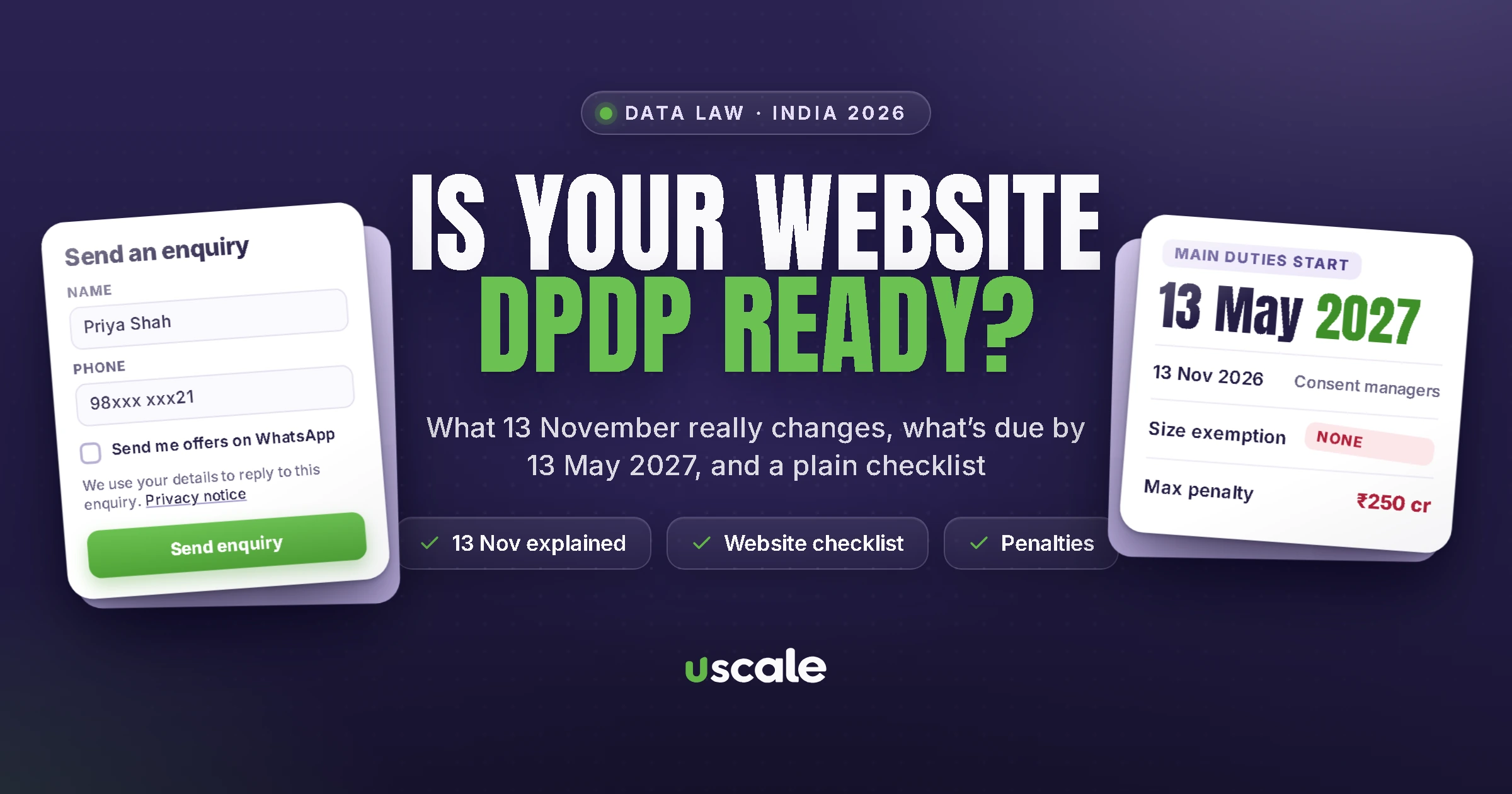
You may have seen posts saying everything changes on 13 November 2026. For an ordinary business, it doesn't. The real date is 13 May 2027. Below: what 13 November actually brings, what the law asks of your website by May, and a checklist you can work through in a few weekends.
What changes on 13 November 2026 (and what doesn't)
The Digital Personal Data Protection Rules, 2025 came in three stages. The gazette is dated 13 November 2025, and Rule 1 sets the clock:
From day one (November 2025): the definitions and the Data Protection Board. The Board exists in law. In August 2026, the government told the Lok Sabha it had advertised for the Board's chairperson and members in June. I couldn't find any appointments announced as of early November.
After one year (13 November 2026): Rule 4, which lets companies register with the Board as Consent Managers. A company needs a net worth of at least ₹2 crore to apply. Using one is optional for you: the Act says a customer "may" manage consent through a Consent Manager.
After 18 months (13 May 2027): everything that affects your website. Notices, consent, security, breach reporting, erasure, children's data and people's rights.
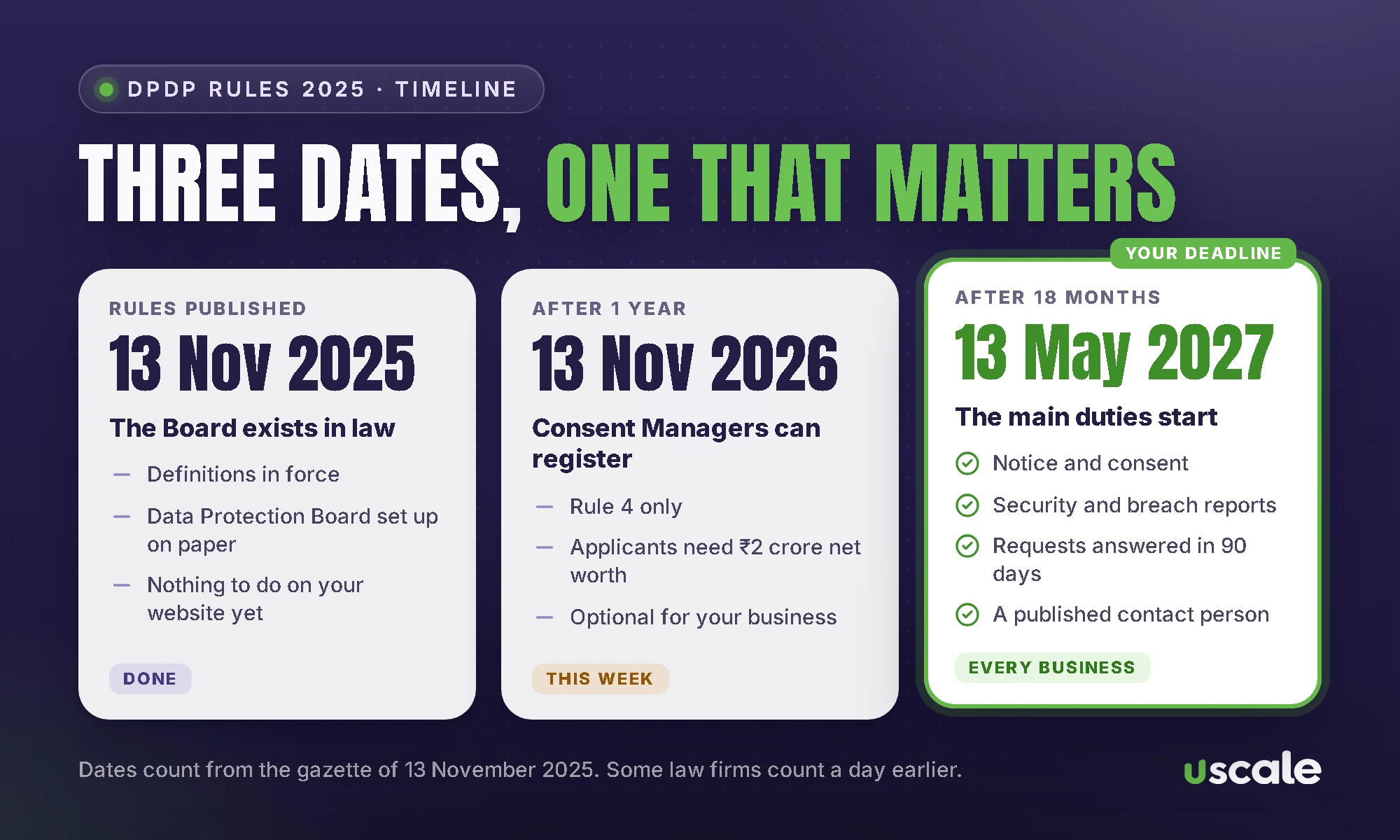
Law firms differ by a day on the exact dates, because the gazette is dated a day before it was published. Khaitan & Co and most others use 13 November 2026 and 13 May 2027. Earlier this year there was talk of cutting the 18 months to 12 for the largest companies. As far as I can find, no change has been notified.
Does the DPDP Act apply to a small business?
Yes. The Act calls anyone who decides why and how personal data is used a "Data Fiduciary", and a person includes an individual, a firm and a company. There's no turnover limit. Law firm ELP calls it "size-neutral": every business gets the same baseline duties.
Three details matter for local businesses:
Paper becomes digital. The Act covers data collected digitally, and data collected on paper that you later type into a computer. The register at your counter is outside the law; the Excel sheet you copy it into isn't.
Work contacts count. Personal data means data about any identifiable individual. The Act has no exception for business-to-business contacts.
Startup relief isn't here yet. Section 17(3) lets the government exempt some classes of businesses, "including startups", from parts of the Act. No such exemption had been notified as of early November 2026.
The DPDP compliance checklist for your website
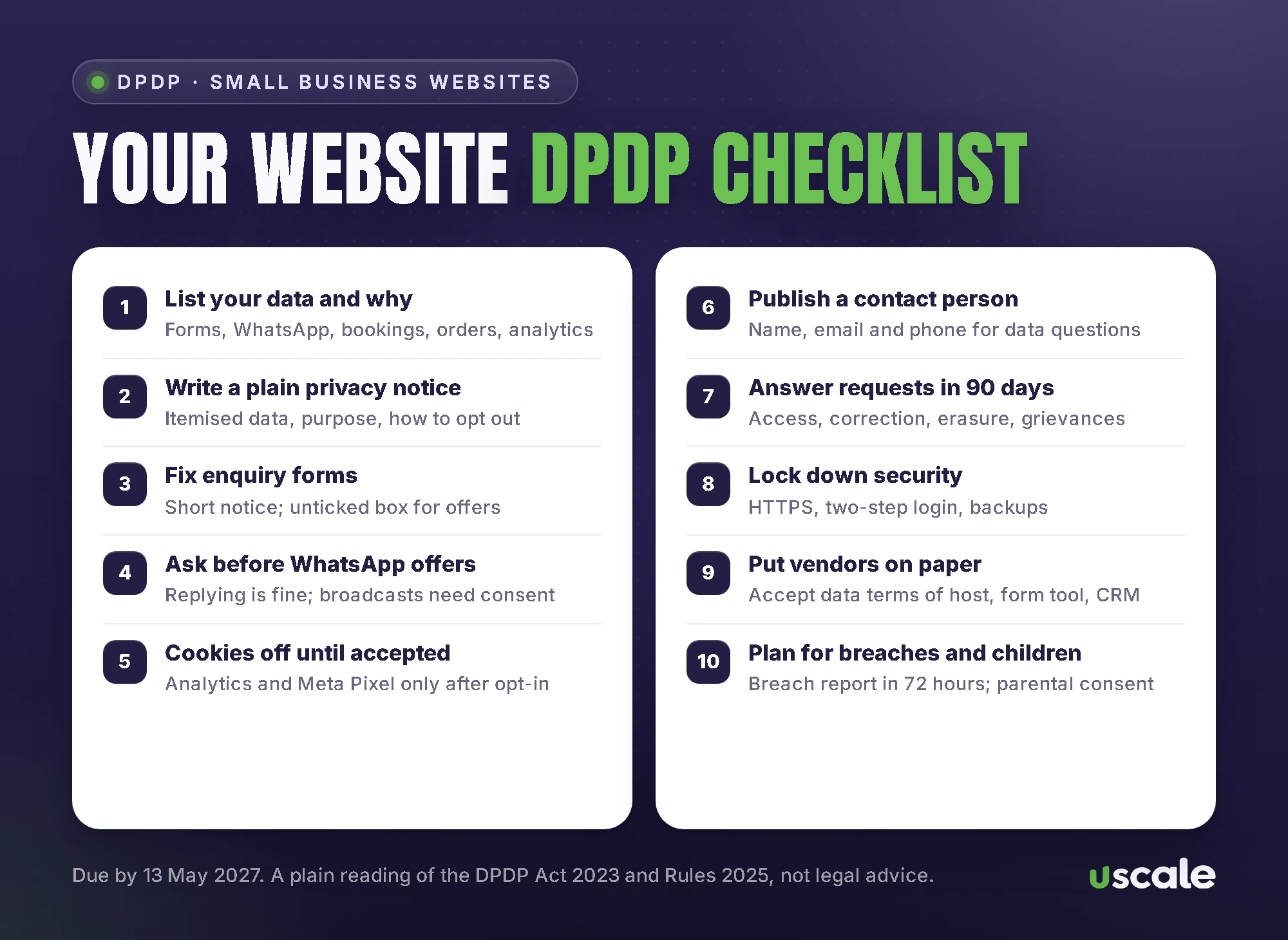
Here's what the Act and Rules ask for, turned into the parts of a small business website. Work through this DPDP compliance checklist in order: each step builds on the one before.
1. List what personal data you collect, and why
Go through your site and write it down: the enquiry form (name, phone, email), WhatsApp chats, bookings, online orders, newsletter sign-ups, and anything your analytics or ad tags collect. Next to each, write the purpose. Everything else on this list depends on it.
2. Write a privacy notice that stands on its own
Rule 3 says the notice must be understandable "independently of any other information", in "clear and plain language", with at least:
an itemised list of the personal data you collect;
what you use it for, and what goods or services that enables;
a link where people can withdraw consent, use their rights and complain to the Data Protection Board.
The Act also says people must have the option to read the notice in English or any of the 22 languages in the Eighth Schedule of the Constitution. My suggestion for a Mumbai business: English plus the language most of your customers use, usually Hindi or Marathi. A 3,000-word policy copied from another website fails the "clear and plain" test. It probably describes data you don't even collect.
3. Fix your enquiry and booking forms
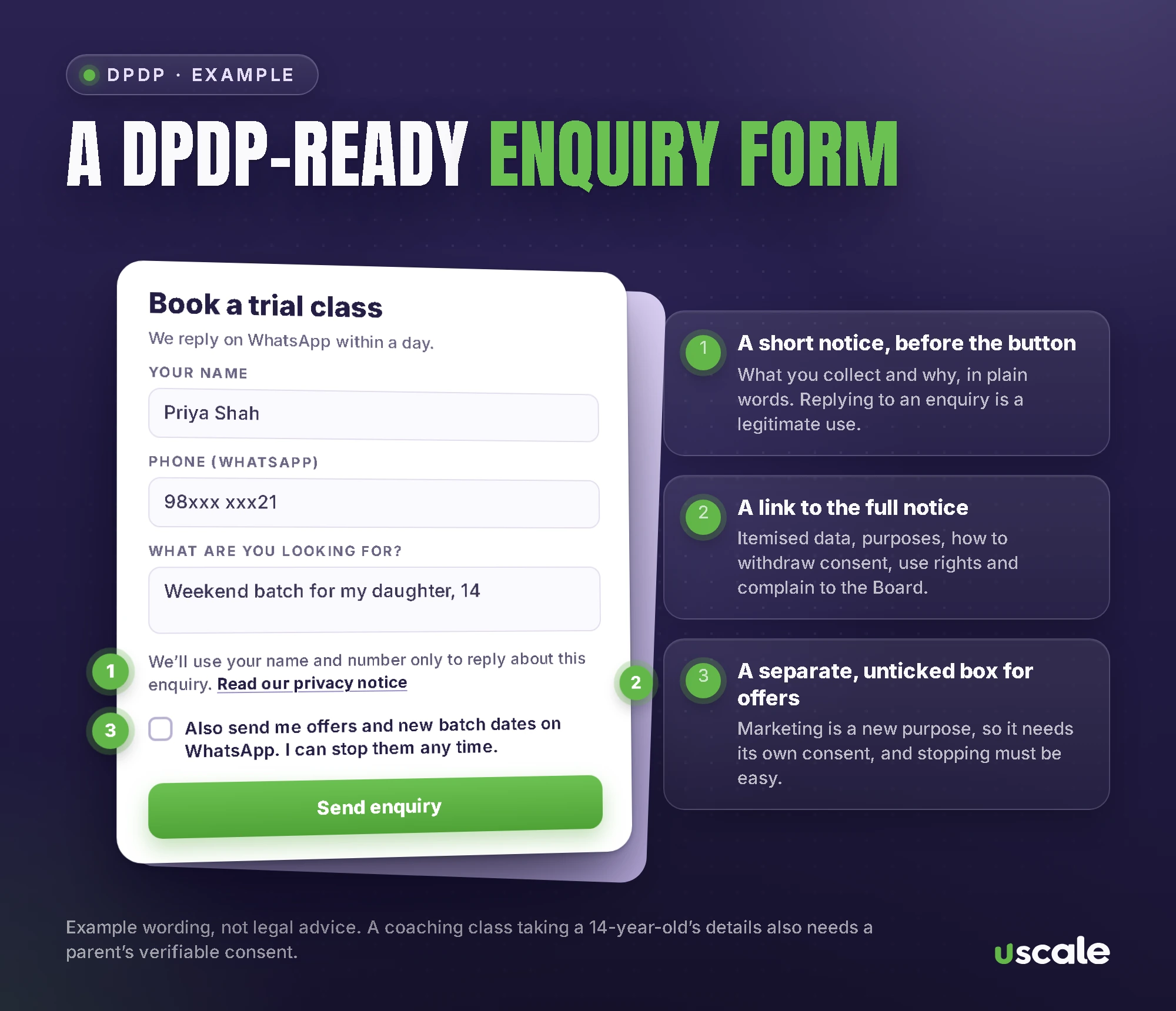
Someone who fills in your enquiry form wants a reply. Section 7(a) lets you use data a person "voluntarily provided" for that purpose, unless they've said no. The Act's own example: a woman messages a property broker to find a flat. The broker can use her details for that, and must stop when she says she no longer needs help.
Sending her offers next month is a different purpose. On a plain reading, that needs consent: a separate, unticked box, not a line hidden in the terms. Above the submit button, add a one-line notice that links to your privacy notice.
4. Treat WhatsApp the same way
When a customer messages you on WhatsApp, replying to them is what they asked for. Adding them to broadcast lists for festive offers is a new purpose, so ask first, and remove them when they ask to stop. The Act says withdrawing consent must be as easy as giving it. If you use the WhatsApp API, Meta's own rules already need opt-in. I've covered the costs in my guide to WhatsApp Business charges in India.
5. Cookies, Google Analytics and the Meta Pixel
The Act never mentions cookies, but law firms agree on how it applies. ELP says sites will need to ask for consent, with a notice, before setting cookies, and warns against a blanket "accept all". Samagra Law says cookies a site needs to work may count as a legitimate use, while tracking and analytics cookies need opt-in consent.
In practice: load only essential cookies by default, and switch on Analytics and the Pixel after a visitor accepts. Make "Reject" as easy to find as "Accept".
6. Publish a contact person
Rule 9 asks every business to "prominently publish" the contact details of "a person who is able to answer" questions about how it processes personal data. For most small businesses that's the owner. Put a name, email and phone number in the privacy notice and the footer.
7. Answer requests within 90 days
People can ask for a summary of the data you hold on them, correct it or have it erased. Rule 14 says you must publish how to make a request. Grievances must be answered within 90 days at most. People have to come to you before they can complain to the Board, so make the process obvious.
8. Lock down security
Rule 6 lists the minimum: encryption or masking, access control, logs of who accessed the data, backups, and keeping those logs for a year. For a small website that means:
HTTPS on every page, and forms that don't email full customer details to five people.
Two-step verification on your website admin, form inbox, Google account and any sheet where leads land.
Only the people who need customer data can see it. Remove staff who've left.
Backups, and a log of who opened what (most good form and CRM tools keep one).
9. Put your vendors on paper
Your web host, form tool, CRM, email software and WhatsApp provider all process customer data for you. Section 8(2) says you can use them only under "a valid contract". For most tools, that means accepting their data processing terms and keeping a copy.
10. Have a breach plan, and know your customers' ages
If customer data leaks, Rule 7 says you must tell each affected person "without delay" and tell the Board. A detailed report to the Board is due within 72 hours. Write down now who does what.
Children need extra care. Anyone under 18 is a child under the Act. Before processing a child's data, you need verifiable consent from a parent. You also can't track children or target ads at them. Run coaching classes, a dance school or a gym with teenage members? This applies to your enquiry form.
What about customer data you already have?
Your old customer list, WhatsApp broadcast lists and past leads don't disappear. Where consent was given before the law started, Section 5(2) says you must send people a notice "as soon as it is reasonably practicable". And Section 8(7) says data must be erased once its purpose is served or consent is withdrawn, unless another law needs you to keep it.
DPDP penalties: the numbers, and the fine print
Every news report leads with ₹250 crore. That's the maximum, for the most serious failure. The Act's schedule says penalties "may extend to":
Failure | Maximum penalty |
|---|---|
Not taking reasonable security safeguards | ₹250 crore |
Not reporting a breach to the Board and to people affected | ₹200 crore |
Breaking the rules on children's data | ₹200 crore |
Any other provision, such as notice and consent | ₹50 crore |
The fine print matters. The Board can penalise only where a breach is "significant". When deciding the amount, it must consider whether the penalty is "proportionate" and its "likely impact" on the business. Nobody should expect a crore-rupee fine for a missing footer link. But security and breach reporting carry the biggest numbers for a reason. They're also the easiest to neglect.
What the DPDP Act doesn't ask of a small business
No Data Protection Officer. Only "Significant Data Fiduciaries", which the government names, need one. You need a contact person.
No registration. Ordinary businesses don't register with the Board. Only Consent Managers do.
No Consent Manager. It's optional for you and your customers.
No fixed three-year deletion clock. That rule applies to e-commerce and social media platforms with at least 2 crore users in India, and gaming platforms with 50 lakh.
A six-month plan to be ready by 13 May 2027
Spread over six months, the DPDP compliance checklist takes a few hours a month:
November: list your data and purposes (point 1), and check who can access your leads.
December to January: write the privacy notice, fix forms and set up a proper cookie banner.
February: turn on two-step verification everywhere, accept vendor data terms, write the breach plan.
March: clean old lists and send your notice to existing customers.
April: test it all: submit your own form, ask for your own data, try to withdraw consent.
Want me to check your website?
Send me your website link. I'll tell you which of these ten points your forms, WhatsApp button and cookies are missing, for free.
If your site needs rebuilding anyway, build these in from the start: a plain-language privacy notice, consent-ready forms and a cookie banner cost far less on day one than as a patch later. Here's what a website costs in Mumbai, and how I build websites for small businesses. For anything high-stakes, such as health records, children's data or a large customer database, talk to a lawyer as well.
Frequently asked questions
Rule 4 of the DPDP Rules 2025 comes into force one year after the Rules were published, which most law firms count as 13 November 2026. It lets companies register with the Data Protection Board as Consent Managers, platforms that help people give and withdraw consent. Nothing new applies to an ordinary business website that day, and using a Consent Manager is optional.
Yes. The Act has no exemption based on size or turnover. If your business collects personal data in digital form, or on paper and later types it into a computer, the Act applies. The government can notify exemptions for some classes of businesses, including startups, but none had been notified as of early November 2026.
The main duties, including notices, consent, security safeguards, breach reporting, erasure and answering people's requests, come into force 18 months after the Rules were published, which is 13 May 2027 by most law firms' count. Some firms count it a day earlier.
The Act doesn't mention cookies. Law firms including ELP and Samagra Law read it as requiring opt-in consent, with a notice, before tracking or analytics cookies such as Google Analytics or the Meta Pixel are set. Cookies the site needs to work may fall under legitimate use. A banner where rejecting is as easy as accepting is the safe choice.
No. Only Significant Data Fiduciaries, a category the government notifies, must appoint a Data Protection Officer. Every business must, however, publish the contact details of a person who can answer questions about how it processes personal data.
The Act's schedule sets maximum penalties of up to ₹250 crore for failing to take reasonable security safeguards, up to ₹200 crore for not reporting a breach or for breaking the rules on children's data, and up to ₹50 crore for other breaches such as notice and consent failures. The Board must keep penalties proportionate and consider their impact on the business.
Written by Mehul Karotra
Mehul Karotra is a UI/UX developer-designer in Mumbai. Through U Scale he personally builds websites and runs SEO, social media, ads and AI search visibility for Indian businesses.