WhatsApp Business Charges in India (2026): What’s Free, What’s Paid and What Changed
Is WhatsApp Business free in India? The app is; the API charges per message. Here’s what each costs in 2026, what changed on 1 October, the 31 December billing deadline, and how to keep your bill small.
 Mehul KarotraFounder, U Scale
7 min read
"Kya WhatsApp Business free hai?" It's one of the questions shop owners ask me most, and in October it got harder to answer. On 1 October 2026 Meta changed what it charges on the WhatsApp Business Platform, and some news reports made it sound as if every WhatsApp business message is now paid. It isn't.
The confusion comes from two different products that share one name: the free WhatsApp Business app on your phone, and the paid WhatsApp Business Platform, usually called the API, which businesses use for automation and bulk messages. This guide covers what each one costs in India today, what changed on 1 October, the 31 December billing deadline, and how to keep your bill small.
The WhatsApp Business app vs the API
Most of the confusion goes away once you know which one you have. If you installed WhatsApp Business from the Play Store and chat from your phone, you're on the app. If a provider such as Interakt, AiSensy or Wati set up automated messages for you, you're on the API.
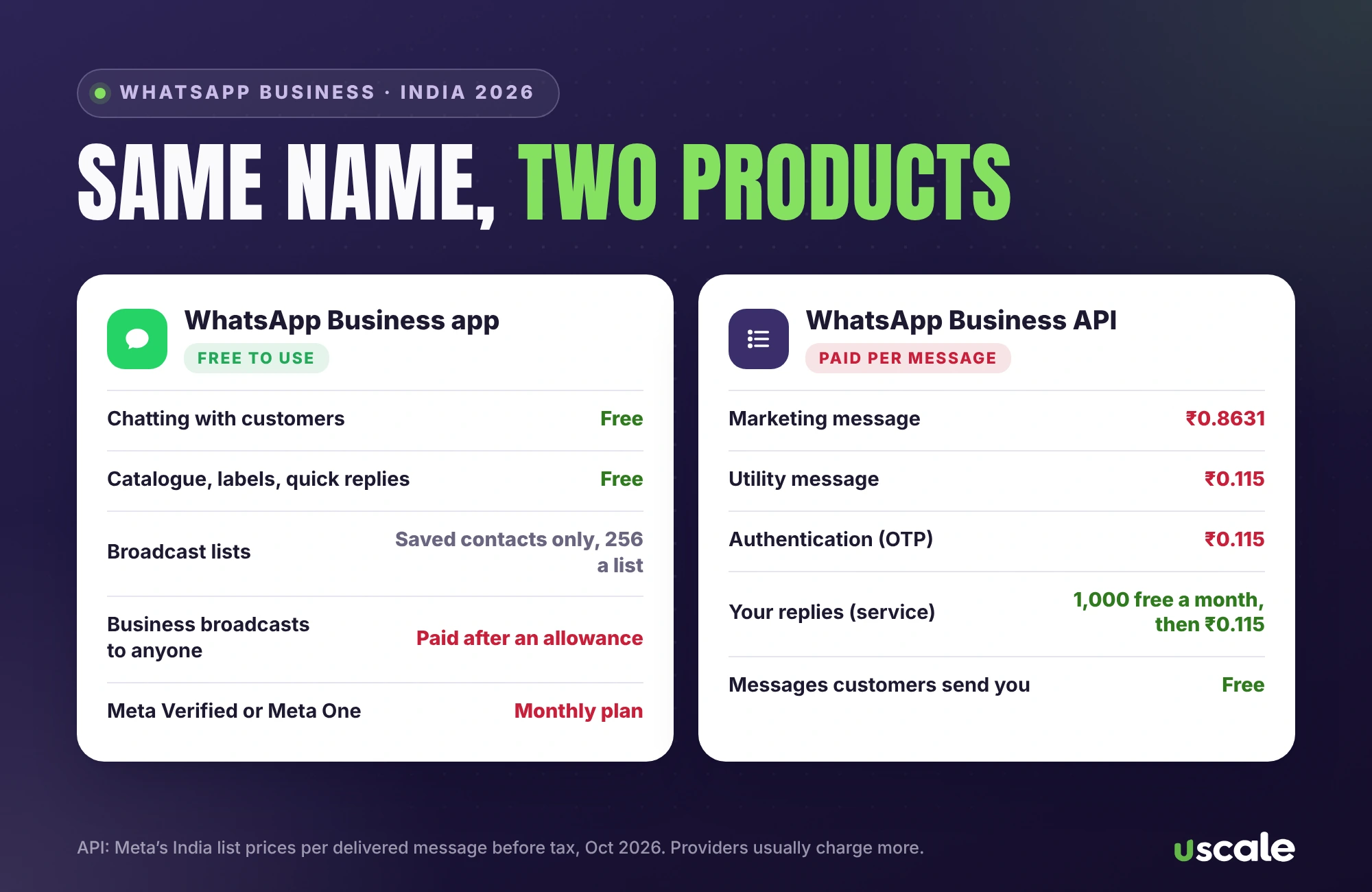
Feature | WhatsApp Business app | WhatsApp Business Platform (API) |
|---|---|---|
Best for | Shops that chat from one phone | Automation, order updates, messages to thousands |
Cost to use | Free | Per message delivered, plus your provider's fee if you use one |
Replying to customers | Free | First 1,000 replies per number each month free, then charged |
Offers to many customers | Broadcast lists (saved contacts only) or the newer business broadcasts (paid beyond any free allowance) | Marketing templates, charged for each one delivered |
Messages customers send you | Free | Free |
What's still free on the WhatsApp Business app
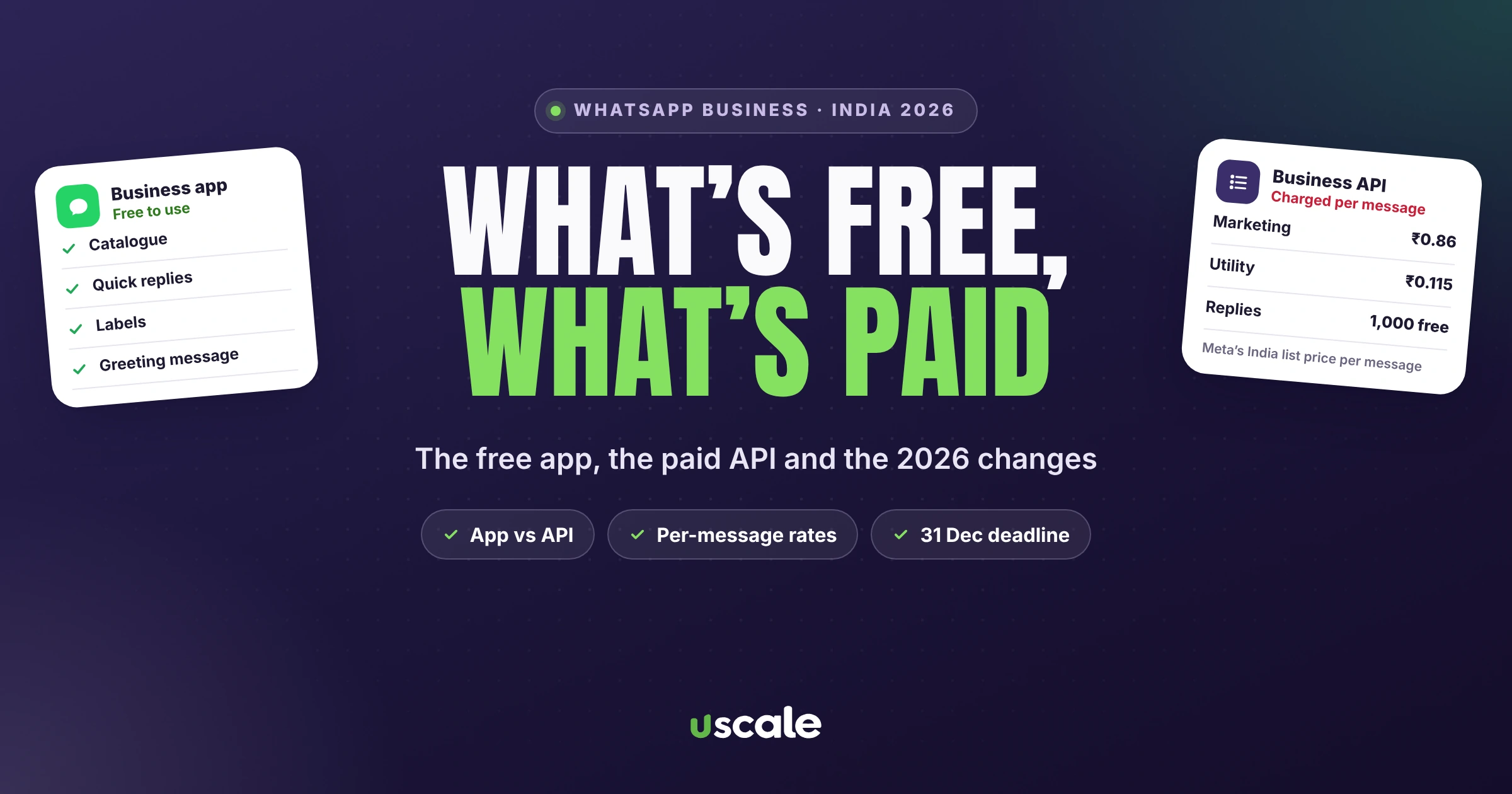
Meta says it plainly on its own page: "The WhatsApp Business app stays free." Chatting with customers, the catalogue, labels, quick replies and greeting and away messages all cost nothing.
What costs money in the app:
Broadcasting beyond saved contacts. Old-style broadcast lists reach only contacts who have saved your number, up to 256 per list. The newer business broadcasts tool (Tools, then Business broadcasts) can message customers who haven't saved your number, but beyond a free allowance it is paid. Meta started charging for this kind of message in India in September 2024. Check the current allowance and price in your app, because Meta changes them.
Meta Verified and Meta One. The verified badge and extra features are a monthly subscription. Meta Verified for businesses launched in India on Instagram and Facebook from ₹639 a month in July 2024, and came to the WhatsApp Business app that September. Meta is now bringing it into Meta One, a new subscription.
Business AI, past a point. The AI that answers customers for you is free "up to an included allowance", Meta says. It hasn't published how big that allowance is.
What changed on 1 October 2026 (API only)
Meta's developer pricing docs list the changes. They apply to the API, not the app:
Replies are no longer unlimited and free. Each business phone number gets 1,000 free service messages (your normal replies inside a customer's 24-hour window) a month. Each one after that is charged. The free 1,000 don't roll over.
Utility templates are charged even inside the 24-hour window. Order confirmations and reminders sent as templates were free inside the window from July 2025. Now they're charged.
A payment method is needed. Without one, replies beyond the free 1,000 stop being delivered.
India's per-message rates did not change on 1 October. India's marketing rate last went up on 1 January 2026.
Also worth knowing: Meta's docs now say that if a customer messages you from a click-to-WhatsApp ad and you reply within 24 hours, your marketing, utility and reply messages to them are free for a window of "up to 7 days". Many older pages still say 72 hours.
WhatsApp API price per message in India (2026)
Message type | What it's for | Meta's list price in India |
|---|---|---|
Marketing | Offers, new arrivals, festive greetings | ₹0.8631 |
Utility | Order updates, bills, appointment reminders | ₹0.115 |
Authentication | One-time passwords (OTPs) | ₹0.115 |
Service | Your normal replies inside the 24-hour window | Free for the first 1,000 a month, then ₹0.115 |
These are Meta's list prices per delivered message before tax, as published by several WhatsApp providers in October 2026. Meta's own INR rate card, downloadable from its developer pricing page, is the final word. If you use a provider, you pay their per-message price, which is usually higher. AiSensy, for example, lists ₹1.09 for marketing and ₹0.145 for utility messages, plus a monthly plan.
What a small shop really pays: an example
Take a boutique in Ghatkopar (an invented example). In a busy month it sends 2,000 marketing messages to customers who opted in, 500 order updates, and 1,400 replies to customer questions.
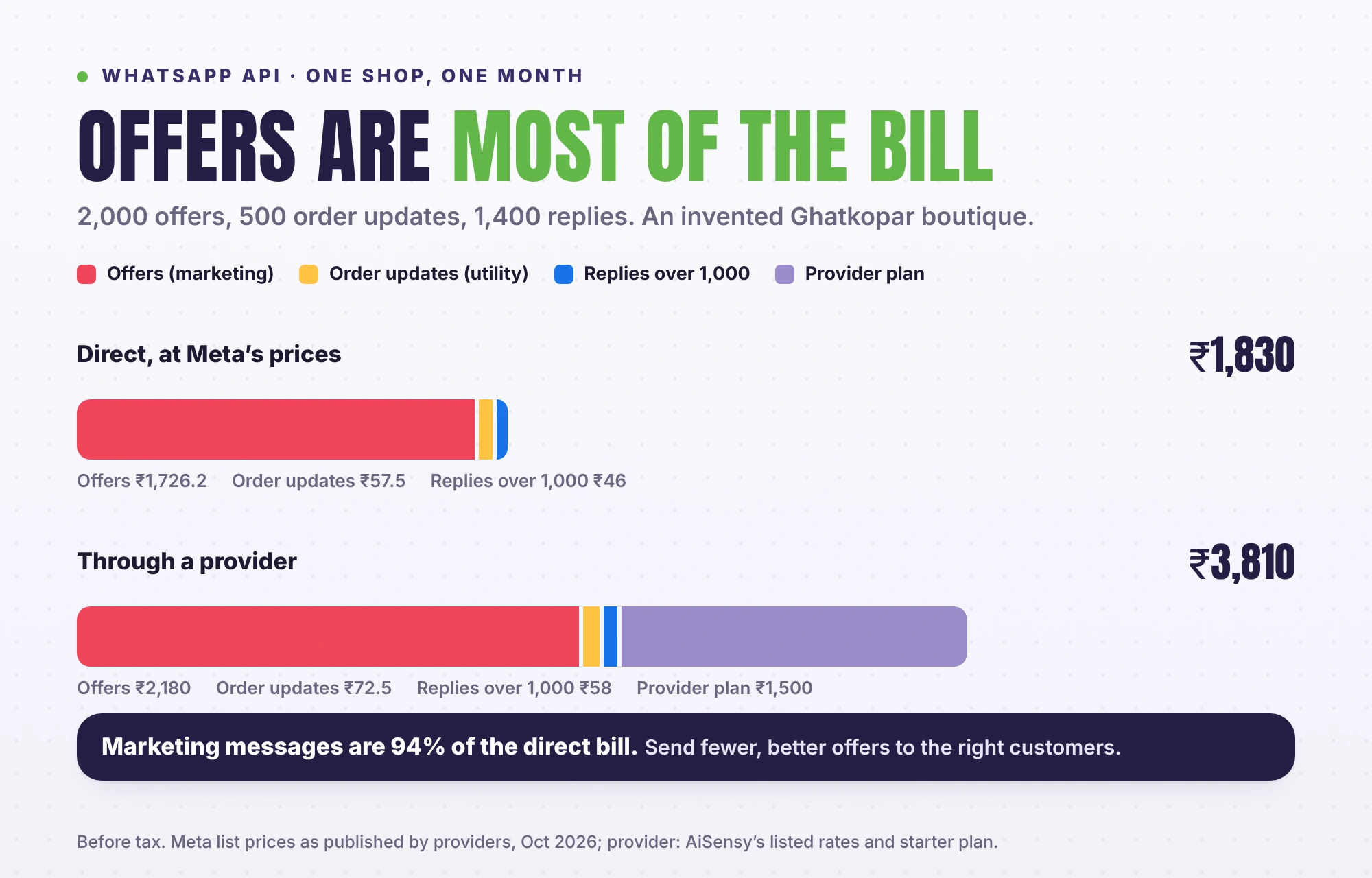
Direct at Meta's list prices: 2,000 marketing messages at ₹0.8631 is ₹1,726. 500 utility messages at ₹0.115 is ₹57.50. Of the 1,400 replies, 1,000 are free and the other 400 cost ₹46. That's about ₹1,830 a month before tax.
Through a provider: at AiSensy's listed prices, the same messages cost about ₹2,310, plus its ₹1,500 starter plan. That's about ₹3,810 a month before tax.
The lesson: marketing messages are more than 90% of the message charges. Replies and order updates barely register. To cut the bill, send fewer and better offers, not fewer replies.
The 31 December rupee billing deadline: who has to act?
Meta's docs say that "Solution Providers and directly-integrated businesses whose Sold-To country is India" must move their WhatsApp billing to rupees by 31 December 2026. From 1 January 2027, Meta "will no longer deliver the messages" of accounts that haven't moved.
On the free app? Nothing to do.
On the API through a provider? Your provider is usually the account holder, so it's their job. Ask them to confirm in writing that your account bills in INR.
Connected to the API directly and paying in dollars? You have to migrate it yourself before 31 December. Meta's docs describe a Currency Migration API for this, so ask your developer.
Rules that can get your number limited
Messaging limits. A new business account can start conversations with 250 unique customers in a rolling 24 hours. The next level is 2,000, which you reach by verifying your business or by sending good-quality messages.
Opt-in. Meta requires customers to have clearly opted in to hear from your business. Buying number lists breaks this.
Quality. Templates that customers block or ignore get a lower rating and can be paused.
Per-customer limits. WhatsApp may limit how many marketing messages a customer gets from all businesses, based on how they engage. If yours are blocked, Meta advises waiting at least 24 hours before trying again.
6 ways to keep your WhatsApp bill down
Send offers to the right people only. Use labels such as "Bridal", "Regular" or "Wholesale" and message each group about what they actually buy, such as bridal offers timed to the wedding season dates. Fewer messages, better results.
Reply with normal messages, not templates. Inside the 24-hour window, a normal reply is free up to 1,000 a month. A utility template now costs money.
Let customers message first. A "WhatsApp us" button on your Instagram profile and website brings customers in, and messages customers send you are never charged.
Use click-to-WhatsApp ads for promotions. Reply within 24 hours and your marketing, utility and reply messages to those customers are free for up to 7 days, per Meta's docs.
Compare providers properly. Add their monthly plan to their per-message markup on your real volumes, not on their example.
Stay on the app if it's enough. One phone, a few hundred regular customers and no automation? The free app and broadcast lists may be all you need.
Not sure if you need the API?
Tell me how you use WhatsApp today. I'll tell you honestly whether the free app is enough, and what the API would cost you each month.
If the API makes sense for you, I set up WhatsApp automation for a one-time ₹8,000, with the WhatsApp platform billed at cost. Details are on my pricing page, and my Google & Meta ads service runs click-to-WhatsApp campaigns.
Frequently asked questions
The WhatsApp Business app is free to use: chatting, the catalogue, labels and quick replies cost nothing. Broadcasts to people who haven’t saved your number, Meta Verified and some extras are paid. The WhatsApp Business Platform (API) is paid per message delivered.
Meta’s list prices in India, before tax, as published by several WhatsApp providers in October 2026, are about ₹0.8631 for a marketing message and ₹0.115 for a utility or authentication message. Replies inside a customer’s 24-hour window are free for the first 1,000 per number each month, then ₹0.115 each. Providers usually charge more per message, plus a monthly fee.
On the API, replies to customers are now free only for the first 1,000 per business number each month, utility templates sent inside the 24-hour window are now charged, and a payment method is required. The free WhatsApp Business app has no per-message charge.
Meta requires India-billed solution providers and directly integrated API businesses to move to rupee billing by 31 December 2026, or their messages stop from 1 January 2027. If you use the API through a provider, ask them to confirm. App users don’t need to do anything.
No. Meta charges businesses only for messages they send. Messages customers send you are free on both the app and the API.
Written by Mehul Karotra
Mehul Karotra is a UI/UX developer-designer in Mumbai. Through U Scale he personally builds websites and runs SEO, social media, ads and AI search visibility for Indian businesses.